For the last two years, everyone was trying to figure out how to invest in AI. Buy the chips. Buy the software. Buy the hyperscalers. The picks-and-shovels trade.
Nobody talked enough about the one thing every single one of those businesses needs more of every quarter. Power.
That’s changing fast. And NextEra Energy (NYSE: NEE) just made a move that could define the next decade of the power story.
The Deal
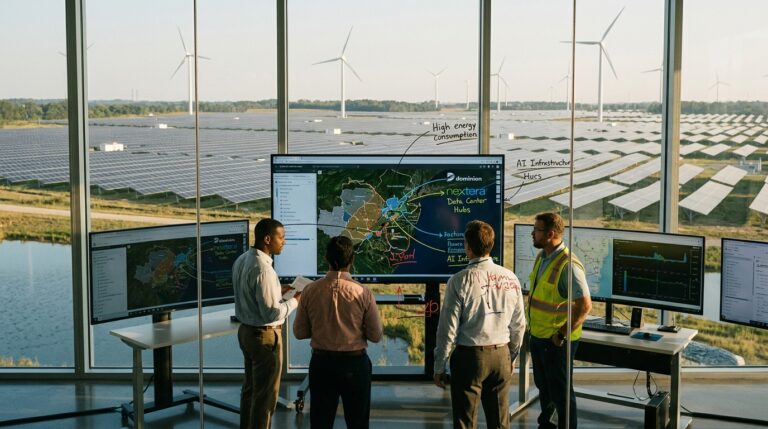
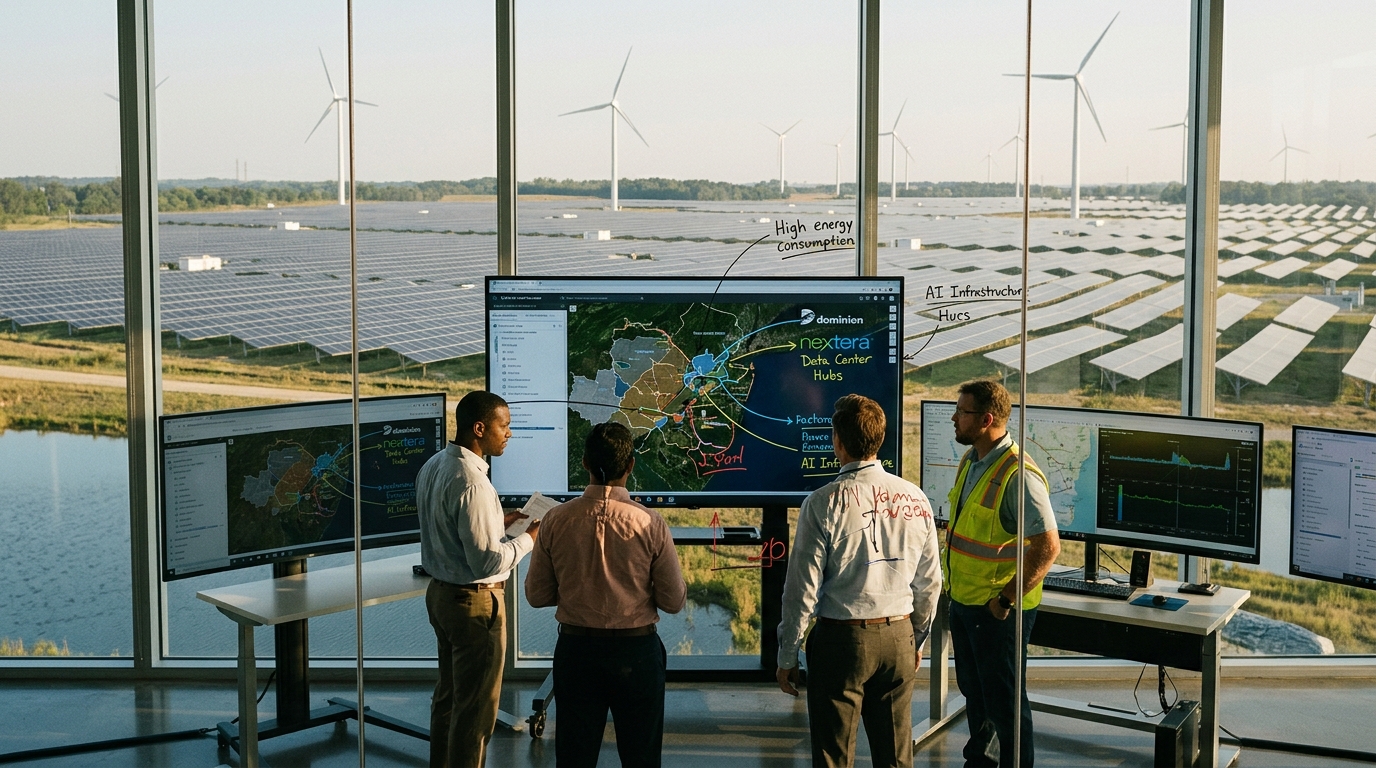
NextEra Energy announced it will acquire Dominion Energy in an all-stock deal valued at about $67 billion, creating what the companies say would be the world’s largest regulated electric utility business by market capitalization. The merger comes as artificial intelligence drives unprecedented electricity demand across the United States, with the combined company positioned to serve approximately 10 million utility customer accounts across Florida, Virginia, North Carolina and South Carolina.
On its own, that sounds like a big utility merger. But the geography makes this something else entirely.
The strategic value is much larger because Dominion gives NextEra direct exposure to one of the most important electricity-demand markets in the world: Northern Virginia’s data-center corridor. Dominion’s Virginia territory is at the center of “Data Center Alley,” where hyperscale cloud and AI data-center demand is creating an unprecedented need for electricity, transmission, substations, gas generation, renewables, nuclear support, and battery storage.
Here’s the number that matters. Dominion Energy Virginia said it has about 51 GW of data-center capacity in various stages of authorization and contracting as of the end of March 2026. And the company has described roughly 70 GW of additional data-center capacity requests in its pipeline.
What NextEra Already Brings
Before this deal even closes, the standalone business is performing.
In Q1 2026, NextEra reported adjusted EPS of $1.09 versus consensus estimates around $1.03. It also reported GAAP net income attributable to NextEra Energy of about $2.18 billion. NextEra Energy Resources added roughly 4 GW of new long-term contracted renewables and storage to its backlog during the quarter, bringing total backlog to approximately 33 GW.
NextEra Energy and Google announced a collaboration tied to restarting the 615 MW Duane Arnold Energy Center in Iowa, including a 25-year agreement for Google to purchase power from the plant. NextEra has said the plant could be back online in early 2029.
NextEra Energy Resources has also been selected in connection with Japan’s $550 billion U.S. investment commitment under the U.S.–Japan trade deal framework to develop 9.5 GW of new gas-fired generation hubs in Texas (5.2 GW) and Pennsylvania (4.3 GW, southwest Pennsylvania). Contracts of that scale don’t come to second-tier players.
NextEra has said the combined company is targeting 9% or greater annual adjusted EPS growth through 2032, supported by 11% annual regulatory capital employed growth and a combined regulated rate base at closing of about $138 billion.
The Bigger Picture – and the Honest Risks
The transaction would significantly expand NextEra’s presence in the PJM Interconnection region, the nation’s largest power grid covering more than a dozen states. The merger reflects growing Wall Street expectations that electricity providers could emerge as major beneficiaries of the AI boom as power demand rises for the first sustained period in decades.
Capacity prices have climbed sharply in PJM, and PJM’s own long-term forecast has projected about 32 gigawatts of summer peak load growth from 2024 to 2030, with roughly 30 gigawatts of that attributed to data centers (about 94%). That demand curve doesn’t reverse.
The deal isn’t done yet, and that’s a real overhang. Regulatory approvals across FERC, state commissions, and the DOJ antitrust process will take time. Analysts have generally expected the transaction to close within 12 to 18 months. A lot can shift in that window. Risks include valuation, execution and integration risk, and the financial and operational impacts of extreme weather events like hurricanes.
But here’s the part worth sitting with: technology platforms can build data centers anywhere, but those facilities require reliable, massive-scale power delivery. Dominion Energy’s established and permitted transmission infrastructure in this specific geographic corridor represents a major strategic asset with high barriers to entry.
You can build a new data center in six months. You cannot build a new power grid in Northern Virginia. That infrastructure took decades. And now it belongs to NextEra.
The AI investment conversation has been almost entirely about who builds the software. The power question has been underpriced. That may not last much longer.