Five days. That’s how long until Micron Technology reports fiscal Q3 2026 earnings after the close on June 24. And right now, heading into that report, the conversation around this stock has shifted in a way that doesn’t happen often.
Analysts are no longer debating whether Micron can grow. They’re debating whether the traditional valuation framework for memory companies still applies at all.
Here’s the recent record, briefly: Micron’s Q2 fiscal 2026 revenue came in at $23.86 billion, up 196% year-over-year and 75% sequentially. Non-GAAP EPS hit $12.20, beating consensus of $8.79 by nearly 39%. Gross margin reached 75%. Free cash flow for the quarter was $6.9 billion. These are not incremental improvements. These are numbers that restructure how you think about the company.
For Q3 — the report due June 24 — Micron itself guided revenue of $33.5 billion, plus or minus $800 million, with non-GAAP gross margins of approximately 81%. Wall Street’s consensus EPS estimate is now $19.72 to $20.25. That represents roughly 960% year-over-year earnings growth. Wedbush raised its price target to $1,300 earlier this week. Stifel Nicolaus went to $1,500. TD Cowen, RBC Capital Markets, and Aletheia Capital raised targets to $1,500, $1,200, and $1,600 respectively. Options traders are pricing a 17.6% swing in either direction around the event.
The stock itself closed around $1,043 on Wednesday, June 17, before markets went into the long weekend. It’s up roughly 70% year-to-date based on multiple data points, and nearly 300% from a year ago.
What’s Actually Driving This
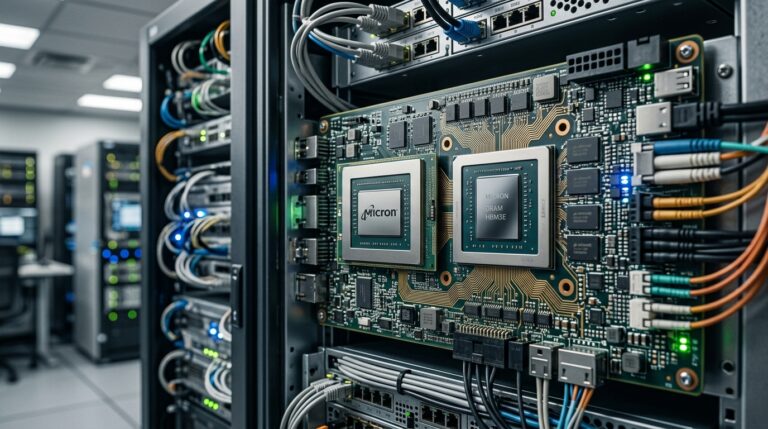
The short answer is High Bandwidth Memory — HBM. It’s a type of advanced DRAM that stacks multiple memory dies vertically to deliver dramatically higher data transfer speeds than conventional memory. Nvidia’s Blackwell GPUs require it. AMD’s AI processors require it. Every major AI data center buildout requires it.
Micron’s entire 2026 HBM production is sold out under binding contracts. Not mostly sold out. Fully contracted. That supply dynamic is what separates this moment from prior memory cycles, where pricing swings were violent and unpredictable because contracts were short and supply could flood quickly. Multi-year agreements, persistent supply constraints, and advanced packaging bottlenecks underpin something closer to durable pricing power rather than cyclical pricing leverage.
The numbers on pricing confirm it. DRAM and NAND average selling prices surged by high double to even triple digits in Q2 of calendar 2026, per Wedbush’s channel checks. Aletheia Capital expects memory prices to rise another 30%–40% quarter-on-quarter in Q3 of calendar 2026, with HBM average selling prices potentially more than doubling by 2027. Those aren’t outlier projections anymore. They’re starting to represent the center of analyst expectation.
Micron’s HBM revenue had already reached an annualized run rate of $8 billion as of the most recently reported quarter. HBM4 capacity discussions for calendar 2026 are reportedly nearly sold out as well. The company is committing roughly $6.4 billion per quarter in capital expenditure to expand manufacturing to meet demand — including a commitment toward $200 billion in new capacity over a multi-year horizon.
The Structural Question
Here’s the part that most of the mainstream coverage isn’t spending enough time on. Memory has always been a commodity business. Pricing went up, supply flooded, margins collapsed, stocks crashed. Every cycle for decades followed that basic rhythm. The question now is whether AI infrastructure demand has broken that rhythm — or just delayed it.
The bull case: AI-driven memory demand is not like PC demand or smartphone demand, which plateaued after initial adoption. Every new AI model generation requires more memory per cluster. Inference workloads — where AI models run in production — are growing even faster than training workloads. Micron’s own roadmap includes HBM4E in development with volume ramp expected in calendar 2027, and a 256-gigabyte LP SOCAMM2 product enabling up to 2 terabytes of memory per CPU. The architecture of AI computing is bending toward more memory, not less.
The bear case: Samsung and SK Hynix are not standing still. SK Hynix is currently the dominant HBM supplier to Nvidia. Samsung is competing aggressively on pricing. When Micron’s $6.4 billion per quarter in capital expenditure eventually adds supply to the market, along with expansions from the other two major players, the pricing cycle could turn faster than the multi-year LTAs suggest. Memory has always reverted. Investors who ignore that history pay later.
The honest position is somewhere between those two views — and the June 24 report will provide the clearest signal yet about which direction the cycle is leaning.
Technical and Positioning Context
Micron is trading in the middle of a strong rising trend on shorter timeframes, with the stock sitting near resistance around $1,064 and support considerably lower near the $935–$940 area. Volume has picked up alongside the recent price action, which is generally a constructive technical signal. The 17.6% implied options move into earnings is significant — that’s roughly $165 per share in either direction based on current pricing. Active traders should consider position sizing accordingly rather than treating this as a binary bet.
The VWAP structure heading into the report is bullish, but the stock is not cheap relative to trailing earnings — it’s cheap relative to forward estimates that themselves carry wide ranges. Analyst revenue estimates for fiscal 2026 span $33.7 billion to $40.9 billion, reflecting genuine uncertainty about how fast AI data center investment sustains at current pace. That dispersion is unusually wide even by semiconductor standards.
Three Scenarios for June 24
Bull Case: Micron reports Q3 revenue near or above $35 billion, gross margins print at or above 81%, and management guides Q4 in the $38–$42 billion range with margin expansion continuing. The structural re-rating thesis accelerates. Stock tests $1,200–$1,300 in the sessions following the report. Options traders with long volatility positions in the right strikes capitalize on the upside move.
Base Case: Q3 revenue comes in at $33–$34 billion, in line with guidance. Gross margins confirm around 80%–81%. Q4 guidance is solid but not dramatically above current consensus. Stock drifts 5%–8% higher post-earnings, institutions continue to accumulate, and the setup into calendar Q3 memory pricing data remains intact.
Bear Case: Revenue meets guidance but Q4 commentary introduces caution — whether around HBM4 ramp timing, competition from SK Hynix, or the capex burden relative to free cash flow generation. The stock pulls back 15%–20% in a post-earnings flush, reverting toward the $850–$900 range where some of the earlier accumulation began. This scenario doesn’t invalidate the multi-year thesis — it reprices the entry point.
Who This Matters To
Growth investors get the clearest signal from the magnitude of earnings growth and the long-term contracted revenue visibility. Options traders face one of the more active implied-move events in the semiconductor space this year, with the 17.6% straddle worth monitoring carefully. Macro-focused investors should note that Micron is a direct read-through on AI infrastructure spending — if the company’s results and guidance confirm that hyperscaler capex is sustaining, that’s a broad market signal, not just a single-stock development. And income investors can observe the free cash flow trajectory: $6.9 billion in Q2 free cash flow, with buybacks potentially increasing as Warsh’s Fed tightens liquidity at the margins — companies that generate their own cash matter more in that environment.
The June 24 print is five days away. The numbers going into it are the strongest in Micron’s history. Whether they get stronger, or whether guidance introduces the first note of caution, is the question the market will spend the next week positioning around.
For informational and educational purposes only. Not investment advice. Trading involves risk, including loss of principal.