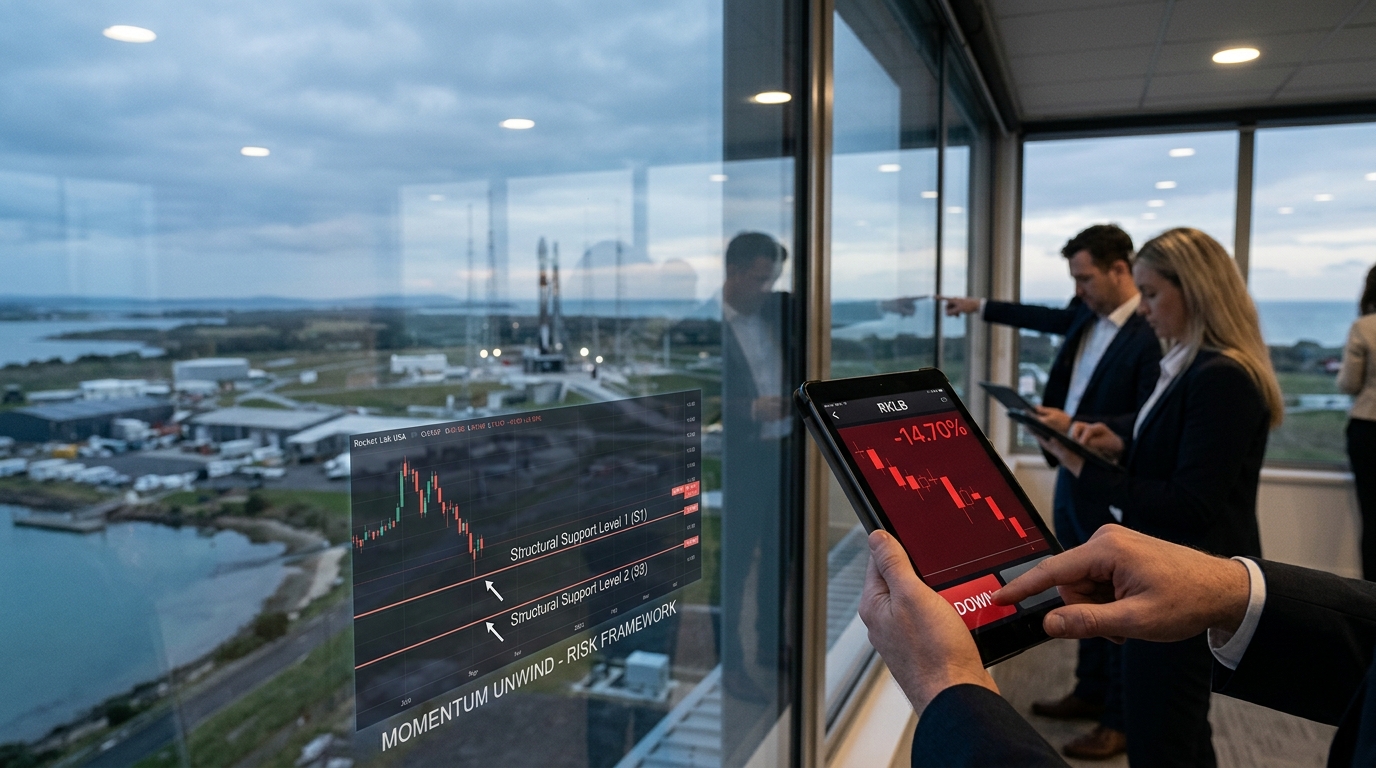
Rocket Lab USA (RKLB) delivered one of the most visually dramatic single-session reversals of June 1, 2026, shedding -14.70% in heavy volume after a multi-week rally that had attracted substantial retail and quantitative momentum positioning. Understanding why this move happened – and what it implies for near-term price structure – requires separating the business fundamentals from the mechanics of a crowded-trade unwind.
The Mechanics of the Decline
RKLB did not decline on a negative fundamental catalyst. There was no earnings miss, no launch failure, no contract loss. The selling pressure was structural and positioning-driven. Quantitative trend-following strategies that had accumulated long exposure during the multi-week advance hit systematic stop thresholds as price broke below key short-term moving average levels. That initial algorithmic selling triggered retail stop-loss orders layered below round-number support zones, creating a cascade that bears the hallmark of a momentum washout rather than a fundamental revaluation.
Options market data reinforces this interpretation. Open interest concentration in near-term call strikes had built significantly during the rally phase, creating a scenario where market makers were long gamma and delta-hedging by selling into strength. As the rally stalled and reversed, that hedging flow accelerated the downside move – a textbook example of options-driven feedback loops amplifying directional price action.
Business Fundamentals Remain Intact
Traders evaluating RKLB as a potential re-entry opportunity need to anchor to the company’s actual financial trajectory. Rocket Lab reported Q1 2026 revenue of approximately $122 million, representing year-over-year growth near 32% – a figure that reflects both its Electron small-launch vehicle business and its rapidly scaling Space Systems segment, which manufactures satellite components and complete spacecraft platforms for government and commercial customers.
The Space Systems segment is particularly significant. It now accounts for a majority of total revenue and carries higher gross margin potential than launch services alone. Backlog figures exceeding $1.07 billion provide multi-quarter revenue visibility that many growth-stage aerospace companies cannot credibly claim. The Neutron medium-lift vehicle program – targeting a first launch in the 2026–2027 timeframe – represents the next major valuation catalyst if development milestones are met.
Valuation and Peer Context
At its pre-selloff peak, RKLB was trading at approximately 18x forward revenue – a premium that reflected both growth enthusiasm and scarcity value as one of the few publicly traded pure-play commercial launch providers. Post-decline, the multiple compresses toward 15x, which remains elevated on an absolute basis but more defensible given the revenue growth rate and backlog coverage ratio. Comparison to aerospace and defense primes like L3Harris or Northrop Grumman is structurally misleading given the growth differential – the more relevant peer frame is high-growth defense-adjacent technology, where 12–20x revenue multiples are not uncommon for companies with credible execution records.
Technical Damage Assessment
The -14.70% session created measurable technical damage. RKLB broke below its 20-day exponential moving average on volume approximately 3.1x the 30-day average – a statistically significant distribution signal. The prior breakout level near the $28.50–$29.00 zone now represents a structural test: if price stabilizes and reclaims this area on declining volume, the selloff retains the character of a healthy consolidation within a larger uptrend. If that zone fails on a subsequent test, the next meaningful support cluster sits near $24.80–$25.40, which corresponds to a prior consolidation base and the rising 50-day moving average.
VWAP from the selloff session anchors near $27.10. Reclaiming VWAP on the following session with above-average volume would be the first technical confirmation that the flush is exhausting rather than accelerating.
Scenario Framing for Active Traders
In a bull case, stabilization above $28.50 over the next two to three sessions, accompanied by a volume dry-up, sets the stage for a re-accumulation phase. Positive Neutron development updates or additional Space Systems contract announcements would provide the fundamental re-ignition the chart requires.
The base case involves a period of choppy, range-bound consolidation between $25.50 and $30.00 as the position base resets – short-term momentum traders exit and longer-duration fundamental buyers absorb supply at discounted levels.
The bear case triggers if the broader market environment deteriorates or if RKLB-specific news – a launch anomaly or program delay – coincides with the current technical weakness, sending price toward the $22.00–$23.00 region where longer-term moving average support converges.
Active traders should size positions relative to defined risk levels rather than attempting to predict the precise outcome of any single scenario.
For informational and educational purposes only. Not investment advice. Trading involves risk, including loss of principal.