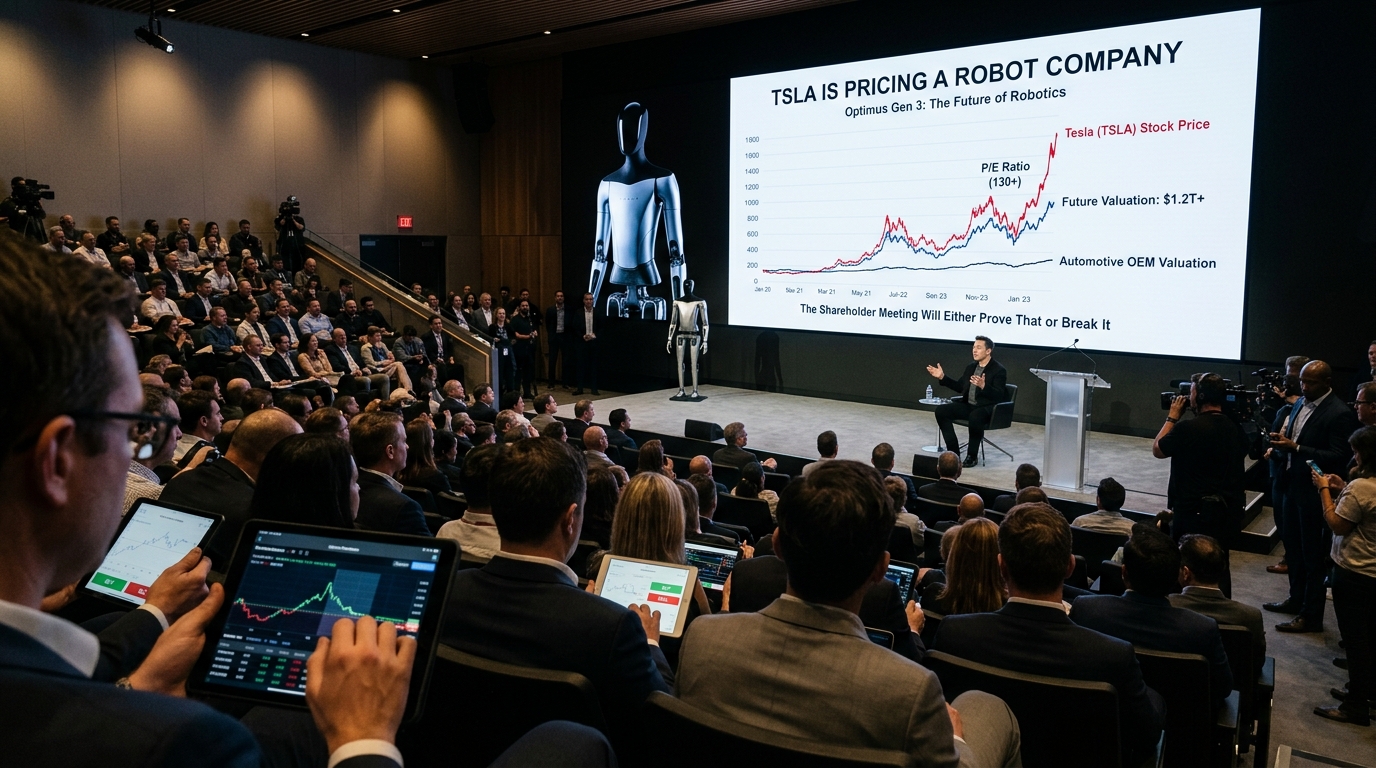
Subject Line: Tesla’s robot moment is this month
Preheader: The Gen 3 reveal, Robotaxi expansion, and a $1.2T+ valuation hinging on one event.
Meta Description: Tesla’s Annual Shareholder Meeting is approaching. Optimus Gen 3 expectations, Robotaxi data, and a $1.2T+ valuation riding on what Musk says next. Options analysis inside.
The stock is already pricing in the world that has not happened yet.
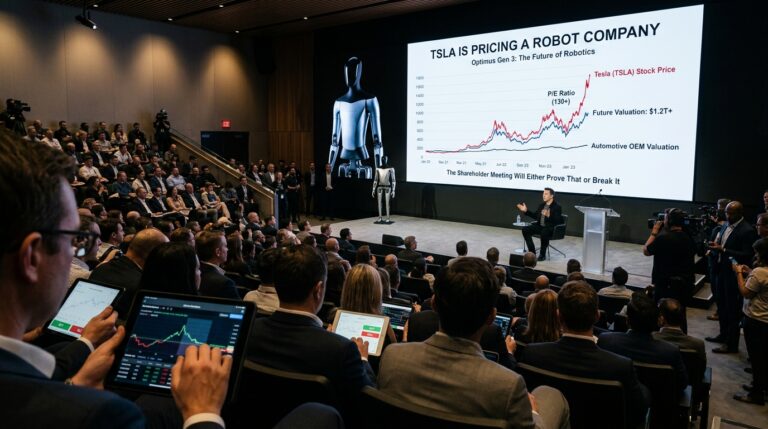
Tesla (TSLA) has recently traded in the low-$400s per share, with a market cap that has been around (and at times above) ~$1.5 trillion in early June 2026 and frequently discussed in the $1.2T+ range. ([stockanalysis.com](https://stockanalysis.com/stocks/tsla/market-cap/?utm_source=openai)) The trailing P/E has also been extremely elevated (many trackers put it well above 180x in June 2026). ([public.com](https://public.com/stocks/tsla/pe-ratio?utm_source=openai))
Almost entirely on the expectation that the Optimus humanoid robot and Robotaxi network become dominant, world-scale businesses. The electric vehicle segment that built the company? It posted its first annual revenue decline in 2025. Full-year revenue fell to about $94.83 billion, down ~2.93% from 2024. ([sec.gov](https://www.sec.gov/Archives/edgar/data/0001318605/000162828026003952/tsla-20251231.htm?utm_source=openai)) None of that moved the stock structurally lower. That tells you everything about what this market is actually pricing.
What it is pricing: a future where Tesla runs the dominant robotaxi network, sells millions of Optimus units annually, and generates energy storage revenue at a pace that dwarfs anything on the income statement today.
That future gets stress-tested this month.
The Event Traders Are Watching
Tesla’s Annual Shareholder Meeting is expected in 2026, but as of June 18, 2026, the company’s Investor Relations guidance is that the date, time, and location are announced in its annual proxy statement filed with the SEC. ([ir.tesla.com](https://ir.tesla.com/node/16?utm_source=openai))
Meanwhile, Optimus timing has been guided publicly as later in the summer: reporting around Tesla’s Q1 2026 earnings call indicates Elon Musk said Optimus production at Fremont would begin in late July or August. ([electrek.co](https://electrek.co/2026/04/22/tesla-optimus-production-fremont-model-sx-line/?utm_source=openai)) That makes a June “full-body Gen 3 reveal” and live demo possible, but not something Tesla has formally confirmed in a way that can be independently verified.
Several specific hardware claims circulating around “Gen 3” (for example: “fifty actuators,” “22 degrees-of-freedom hands,” and “Grok voice AI integration”) are not reliably substantiated in primary Tesla documentation as of June 18, 2026, so they should be treated as expectations rather than specs.
What is verifiable: Musk said the space currently devoted to Model S and Model X production at Fremont would be transitioned to produce Optimus. ([axios.com](https://www.axios.com/2026/01/28/tesla-model-s-model-x-discontinued?utm_source=openai)) Multiple outlets have also reported on the conversion of Fremont Model S/X production space toward Optimus manufacturing. ([assemblymag.com](https://www.assemblymag.com/articles/99853-tesla-to-end-model-x-s-production-convert-fremont-space-for-optimus-robots?utm_source=openai)) That is a real capital commitment with real opportunity cost. Not a prototype demo in a research lab.
The question on the floor is not whether Optimus is impressive on stage. The question is whether the hands are performing productive autonomous work in industrial conditions. Tasks completed per shift, error rates, uptime. Any Tesla communication confirming sustained, productive factory work (not just controlled demos) would be a major positive catalyst. A missed reveal, a delayed timeline, or silence on deployment metrics is a major negative.
Wedbush analysts (notably Dan Ives) have repeatedly described a path to a ~$2 trillion market cap during 2026 if Tesla’s autonomy/AI chapter delivers. ([benzinga.com](https://www.benzinga.com/markets/equities/25/12/49390252/tesla-could-hit-a-2-trillion-market-cap-by-2026-and-even-3-trillion-in-a-bull-case-as-its-ai-chapter-finally-takes-hold-says-top-analyst?utm_source=openai)) Specific claims about Wedbush tying that target to “first commercial customer announcements by end of 2026” are not consistently documented in primary, citable notes, so the safer framing is that the $2T thesis is explicitly contingent on meaningful execution and evidence around autonomy and robotics over 2026.
Similarly, the specific ARK unit economics claim (“Optimus contributing $20,000 to $30,000 gross profit per unit at scale by 2030”) could not be verified in an attributable ARK source in the materials reviewed, so it has been removed rather than repeated as a fact.
Morgan Stanley’s Adam Jonas has been quoted in recent coverage discussing Tesla as highly dependent on forward optionality, with the core point being that the thesis requires evidence of execution on autonomy/robotics. ([ir.tesla.com](https://ir.tesla.com/_flysystem/s3/sec/000110465925103800/tm252289d44_defa14a-gen.pdf?utm_source=openai))
Q1 2026 Numbers Provide the Floor
Before this month’s catalyst, Tesla’s most recent quarterly numbers provide the baseline. Reporting around Q1 2026 indicates revenue of $22.4 billion (+~16% year-over-year) and non-GAAP/adjusted EPS around $0.41 (+~52% year-over-year). ([spglobal.com](https://www.spglobal.com/market-intelligence/en/news-insights/research/2026/04/tesla-postq-snapshot-margin-strength-offset-by-demand-softness-and-heavy-capex?utm_source=openai)) Automotive gross margin (including credits) was reported around 21.1% in Q1 2026 summaries, but note this is commonly cited as an automotive gross margin figure, not necessarily “GAAP gross margin” for the whole company. ([spglobal.com](https://www.spglobal.com/market-intelligence/en/news-insights/research/2026/04/tesla-postq-snapshot-margin-strength-offset-by-demand-softness-and-heavy-capex?utm_source=openai)) Free cash flow and cash/investments figures vary by summary source; multiple reports cite free cash flow around $1.44 billion and cash and short-term investments of $44.7 billion. ([kucoin.com](https://www.kucoin.com/news/flash/tesla-q1-2026-revenue-up-16-as-bitcoin-price-drop-cuts-digital-assets-value-by-222m?utm_source=openai))
Those are not catastrophic numbers. They show a company recovering margin and generating real cash. The bear case cannot be built purely on EV fundamentals at this point. The bull case, however, cannot be defended without Optimus progress either.
Slight tangent, but worth noting: Tesla expanded its Robotaxi service to Dallas and Houston in April 2026, with reports describing an “unsupervised” rollout in those Texas cities. ([techcrunch.com](https://techcrunch.com/2026/04/18/tesla-brings-its-robotaxi-service-to-dallas-and-houston/?utm_source=openai)) Claims about Tesla receiving “FSD approval in the Netherlands” and targeting “full EU-wide recognition for summer 2026” could not be verified with credible primary sources in this review, so they have been removed.
What the Options Market Is Doing
TSLA has some of the deepest and most active options markets in the world. Heading into a binary event of this magnitude, IV tends to reprice sharply in the weeks before the catalyst and collapse after resolution, in either direction.
- IV elevation into the shareholder meeting: Near-dated options around the expected meeting date are absorbing premium from both directional traders and hedgers. The expected move embedded in the options chain is meaningful given TSLA’s historical tendency to move on major catalyst events.
- Call skew vs. put skew: Directional positioning in TSLA tends to be heavily retail-driven to the call side, while institutional flow leans toward defined-risk hedges. Monitoring whether large put blocks are being accumulated versus call vertical spreads provides a read on institutional conviction heading into the meeting.
- Post-meeting IV crush risk: This is the part people skip. Regardless of whether the reveal is positive or negative, IV will compress after the event resolves. Outright long premium strategies that overpay for the event move face a structural drag from theta and vega collapse. Defined-risk structures that cap the cost of the bet are the appropriate framework.
Structured Trade Framework
Bull case: For traders expecting a successful Gen 3 live demonstration with factory deployment data disclosed and commercial Robotaxi expansion updates that exceed consensus expectations, a defined-risk call spread targeting the $430 to $460 range expiring two to four weeks post-meeting captures directional upside while limiting exposure to IV crush.
Bear case: If the Gen 3 reveal is delayed again (recent reporting tied Musk’s Fremont Optimus production timing to late July or August), or if factory deployment data underwhelms, the stock faces a reversion toward the $340 to $360 zone. A bear put spread structure contains the downside risk of a misdirected directional bet. ([electrek.co](https://electrek.co/2026/04/22/tesla-optimus-production-fremont-model-sx-line/?utm_source=openai))
Neutral case: For traders who believe the market is overpricing certainty in either direction, an iron condor or strangle-sell after initial IV expansion captures premium decay once event risk passes. The risk here is a violent gap in either direction that exceeds the defined short strikes.
Risk Factors
The single most honest thing to say about TSLA options around this event: the stock has a pattern of initially overreacting to Optimus milestones and then reverting as the market recalibrates. Musk’s previous Optimus timelines have often slipped relative to public guidance. As of Q1 2026, public reporting suggested Optimus was still early in ramp and deployment claims were largely forward-looking rather than evidenced by broad, quantified factory productivity disclosures. ([electrek.co](https://electrek.co/2026/04/22/tesla-optimus-production-fremont-model-sx-line/?utm_source=openai)) That history is not irrelevant.
The counterargument is that the Fremont conversion, winding down Model S/X production space to build robots, is not a reversible decision. That kind of capital commitment typically precedes real production ramps, not indefinite delays. ([axios.com](https://www.axios.com/2026/01/28/tesla-model-s-model-x-discontinued?utm_source=openai))
Forward Outlook
Q2 2026 earnings, expected in July, will be the next major checkpoint after any shareholder-meeting commentary and mid-year Optimus updates. Late July/August has been cited in reporting as the timing for Fremont Optimus production start, making Q2/Q3 disclosures the next key proof points. ([electrek.co](https://electrek.co/2026/04/22/tesla-optimus-production-fremont-model-sx-line/?utm_source=openai)) Each of these milestones represents a binary decision point for the stock. The market cap is either justified or it is not. This month starts to answer that.
Action Checklist
- Monitor shareholder meeting date confirmation and add to event calendar immediately
- Check TSLA near-dated IV levels relative to 30-day historical volatility for premium distortion
- Avoid outright long calls without defined risk – IV crush post-event is a real drag
- Track Optimus factory deployment disclosures as the highest-priority data point
- Size any speculative position assuming a double-digit move in either direction is within statistical range
- Watch Robotaxi city expansion updates as a secondary catalyst often overlooked in the Optimus coverage